



How can industrial routers improve network reliability through redundancy design?
Release Time : 2025-12-05
As a core device in the Industrial Internet, the network reliability of industrial routers directly impacts the continuity of production systems. Redundancy design, through the deployment of backup components or paths, automatically switches over in the event of a primary device failure, eliminating the risk of single points of failure. This design is particularly important in industrial scenarios, as production line equipment typically requires 24/7 uninterrupted operation; any network outage can lead to production halts or data loss. The redundancy design of industrial routers encompasses multiple layers, including hardware, links, protocols, and power supplies, forming a multi-layered protection system.
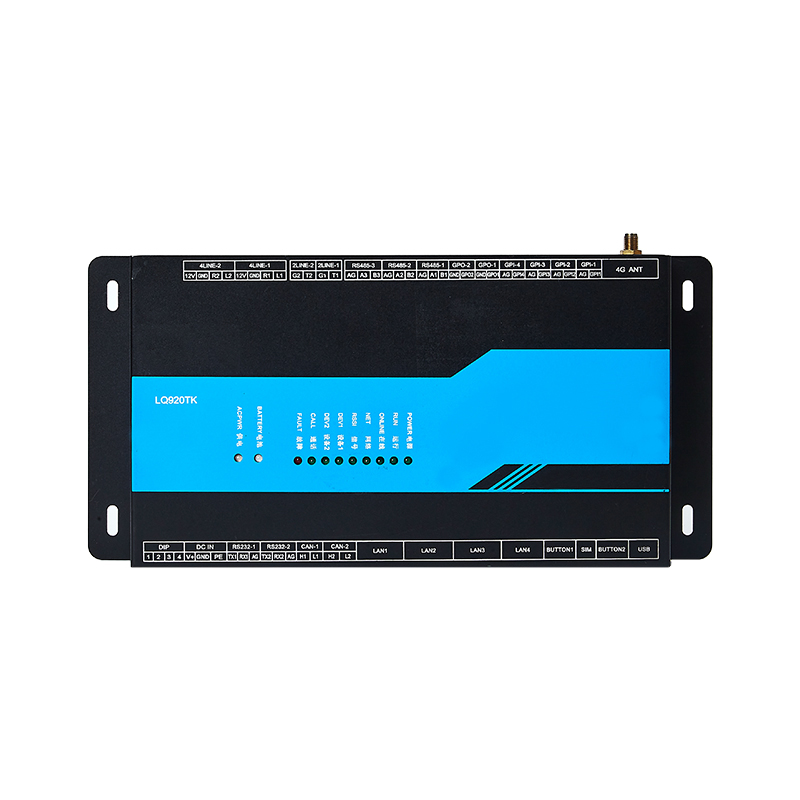
Hardware redundancy is the fundamental guarantee of industrial routers. High-end industrial routers support dual main control board hot backup, with two main control boards operating synchronously. When the primary board fails, the backup board can take over all functions within milliseconds, ensuring uninterrupted routing decisions and protocol processing. Some models also support dual power modules, supplying power to the device through independent power input channels. Even if one power supply fails, the other can still maintain device operation. This design is especially important in industrial environments with frequent power fluctuations, preventing equipment restarts due to voltage instability.
Link redundancy improves network availability through multi-path transmission. Industrial routers typically feature multiple Ethernet interfaces and support link aggregation technology, binding multiple physical links into logical links. When one link fails, traffic automatically switches to other working links without manual intervention. Furthermore, industrial routers support multi-carrier access, achieving WAN-level redundancy by simultaneously connecting to networks of different carriers. When the primary link is interrupted due to carrier failure, the device automatically switches to the backup link, ensuring the continuity of remote monitoring and data transmission.
Protocol redundancy is key to seamless switching in industrial routers. The VRRP protocol virtualizes multiple routers into a single logical device, providing a unified virtual IP address. The primary router forwards traffic, while the backup router monitors the primary device's status in real time. When the primary device fails, the backup device immediately takes over the virtual IP address; the switching process is transparent to the end devices. The STP protocol prevents switch loops by blocking redundant links to avoid broadcast storms while retaining links as backups. When the primary link fails, the STP protocol automatically activates the backup link, restoring network connectivity.
Power redundancy design ensures the stability of industrial routers in extreme environments. Industrial-grade equipment typically employs a wide-voltage input design, supporting both AC and DC power supply to adapt to the power conditions of various industrial scenarios. Some high-end models are also equipped with power redundancy modules, achieving zero-interruption switching in the event of power failure through dual power inputs and intelligent switching circuits. Furthermore, industrial routers feature metal casings, providing dustproof, waterproof, and electromagnetic interference protection, and can operate stably within a wide temperature range of -40℃ to 75℃, adapting to harsh industrial environments.
The redundancy design of industrial routers is also reflected at the management level. Through a centralized management platform, maintenance personnel can monitor the operating status of all devices in real time, including parameters such as link quality, power status, and temperature. When an anomaly is detected, the system automatically triggers an alarm and generates a maintenance work order. Some platforms also support configuration backup and recovery functions, allowing for rapid synchronization of configuration files to backup devices, shortening fault recovery time. This proactive management approach significantly improves network maintenance efficiency and reduces the risk of human error.
In practical applications, the redundancy design of industrial routers needs to be optimized based on specific scenarios. For example, in smart manufacturing workshops, routers need to connect to PLCs, sensors, industrial robots, and other equipment simultaneously, placing extremely high demands on real-time performance and reliability. In this case, a dual-core switch + dual-link aggregation architecture can be adopted to ensure that any single point of failure will not affect the production process. In energy monitoring scenarios, routers need to connect wirelessly to monitoring terminals in remote areas. In this case, a 5G backup link + solar power supply solution can be used to improve data transmission reliability.
Industrial routers, through redundant design at the hardware, link, protocol, power supply, and management levels, construct a multi-layered, comprehensive reliability assurance system. This design not only improves the stability of the network itself but also lays a solid foundation for the intelligent upgrade of the Industrial Internet. With the advancement of Industry 4.0, the redundancy design of industrial routers will develop towards a more intelligent and automated direction. For example, AI-based fault prediction and adaptive link switching technologies will further promote the improvement of industrial network reliability.